
Bank connectivity in Odoo
Isabel, CODA, PSD2, EBICS or CodaBox?
Five ways to get your bank data into Odoo. None of them is best in every case.
Here is how to choose and in which situations each one is the wrong answer.

Two families, not five
Before comparing tools, you need to understand the dividing line. It does not run between vendors but between two kinds of data.
The transaction feed
This is what most modern bank connectors provide, the ones relying on the European PSD2 directive. You receive a list of movements: date, amount, counterparty, label. It is quick to set up and often included in your subscription.
But that feed does not carry the accounting structure of a statement. There is no statement number, no opening balance, no closing balance. In other words: you cannot prove nothing is missing.
The structured statement
A CODA file (the Belgian bank format) or its international equivalents MT940 and CAMT.053, contains the complete accounting object: the statement sequence number, the opening balance, every movement with its structured details, and the closing balance. The statement closes on itself.
That property is what matters. If the closing balance of statement 47 matches the opening balance of statement 48, you know no movement has been lost. That is what an auditor looks for, and what makes a bank reconciliation defensible.
The three-question test :
Look at a statement imported into your Odoo.
- Does it have a number?
- An opening balance?
- A closing balance?
If any answer is no, you are working on a transaction feed, not on statements and your closing rests on an assumption.
The five methods, one by one
Odoo native synchronisation (PSD2)
How it works. Odoo connects to your bank through an aggregator, with your online consent.
What you get. A transaction feed, often several times a day.
What you do not get. Opening and closing balances, statement numbers, and outgoing payments.
The friction point. PSD2 requires periodic re-consent. In practice someone has to reconnect regularly, and if nobody does, the feed stops silently.
Right choice if you have one or two banks, few movements, no batch payments to sign, and your closing is not audited.

CodaBox
How it works. A Belgian service that collects CODA files from the banks and delivers them to accounting firms.
What you get. Genuine structured CODA statements, and often the SODA files from your payroll office.
What you do not get. Payment issuance. It is an inbound channel only.
The friction point. You do not control the channel: it belongs contractually to your accounting firm. Any change, a new account, a change of bank, terminating the service, goes through them. And if you change accountant, the channel question reopens.
Right choice if your accounting firm already receives your CODA this way and you have no need to issue payments from Odoo.

Manual import
How it works. You download the files from the bank portal and drop them into Odoo.
What you get. Exactly the same data as Isabel or CodaBox. The accounting quality is identical.
The friction point. Someone has to do it, every day, for every account. That is where omissions hide, and the real cost is your team's time.
Right choice if you are starting out, or to validate a configuration before automating.
EBICS
How it works. A European standard for machine-to-machine file exchange, with certificates and distributed signature.
What you get. Structured statements and outgoing payments, with no intermediary, including internationally.
The friction point. Setup is negotiated bank by bank, and not all offer it on the same terms. It takes longer to start.
Right choice if you are a multi-country or multi-bank organisation outside Belgium, or if you want to be free of any third-party platform.
Isabel 6 + Isabel Connect
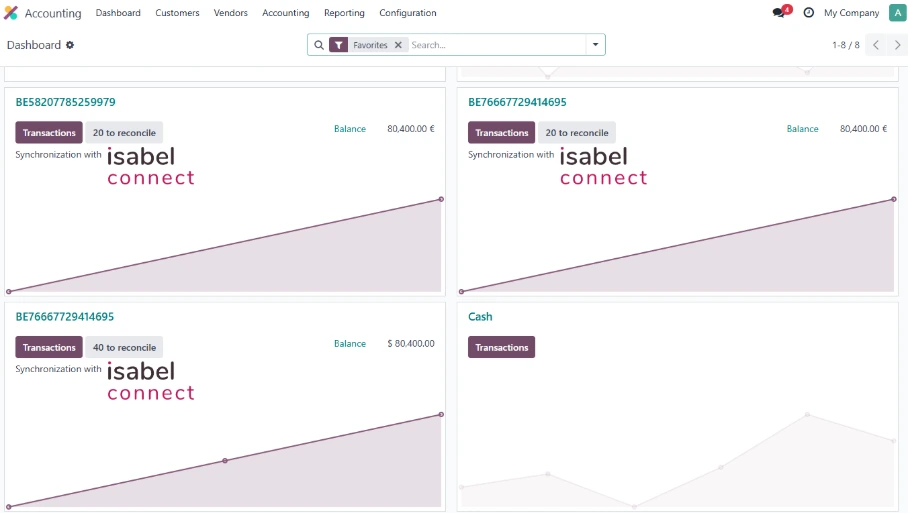
How it works. Isabel is the Belgian multibank platform. Isabel Connect links it to Odoo in both directions.
What you get. CODA files imported automatically every morning, and payment batches sent from Odoo in one click, approvals staying inside Isabel, with itsme® or Isakey.
The cost. Your Isabel subscription, billed by Isabel, plus the Noviat licence at 1 000 €/year per database.
The friction point. An Isabel contract is required. It does not pay off for a company with a single bank and twenty movements a month.
Right choice if you have several banks, payments requiring multiple signatories, and a closing that has to hold up.
What a reliable close actually needs
A bank statement is not a list of movements. It is a document with a number, an opening balance and a closing balance, and those three things are what let you prove that nothing is missing.
Where it shows up. On a transaction feed you can reconcile day to day and still be unable to say, at year end, that the account is complete. With structured statements the arithmetic closes by itself: opening balance plus movements equals closing balance, or something is wrong and you know it that morning.
What it costs to get this wrong. Rebuilding a year of bank history from an incomplete feed is a week of work for someone who has better things to do, and it happens at the worst possible moment.
The comparison table
The criteria that actually decide, not the ones that look good in a brochure.
| Criterion | Odoo native (PSD2) | CodaBox | Isabel Connect | EBICS | Manual import |
|---|---|---|---|---|---|
| Nature of the data | Transactions | CODA statements | CODA statements | Structured statements | Structured statements |
| Statement number | No | Yes | Yes | Yes | Yes |
| Opening and closing balances | No | Yes | Yes | Yes | Yes |
| Outgoing payments from Odoo | No | No | Yes | Yes | File uploaded by hand |
| Who can subscribe | You | Accounting firm only | You | You | You |
| Multibank | Depends on the aggregator | Yes (Belgium) | Yes | Yes | Yes |
| Re-authentication | Periodic, imposed by PSD2 | No | Infrequent, on the Isabel side | No, certificates | Every download |
| Automation | Yes | Yes | Yes, daily | Yes | No |
| Setup effort | Low | Medium, via the accounting firm | Medium | High, bank by bank | None |
| Annual cost | Often included in the subscription | Billed to the accounting firm, passed on or not | Isabel subscription + 1 000 € Noviat per database | Bank fees + integration | Zero euro, but time every day |
| Audit robustness | Low | Good | Good | Good | Good |
| Outside Belgium | Depends on the banks | No | Accounts linked to Isabel | Yes | Depends on the bank |
How to choose, in practice
In this section, you can address common questions efficiently.
One bank, few movements, no batch payments
Stay on Odoo's native synchronisation. It is enough, it is included, and paying more would bring you nothing.
Just keep an eye on re-consent.
Your accounting firm already receives your CODA
Talk to them before anything else: the channel may already exist and you may only be missing a configuration on the Odoo side.
Remember that the subscription remains theirs, not yours.
Several banks, and payments requiring signatures
This is the typical Isabel case. The trigger is not importing statements, it is the moment you need to issue payments with several signatories without handling files.
Several countries, or a wish for independence
EBICS. Heavier to set up, but with no intermediate platform and no geographic limit.
These methods are not mutually exclusive.
Isabel Connect and EBICS can run side by side on the same Odoo instance.
One bank reached through Isabel, another over EBICS, in the same accounting.
The same goes for receiving statements through one channel and issuing payments through another.
There is nothing wrong with that, provided it is a decision rather than an inheritance, and provided you avoid importing the same statement twice.
EBICS bank connectivity
The European machine-to-machine standard, with no intermediate platform, and fully compatible with Isabel on the same database.
EBICS in Odoo
Isabel Connect for Odoo
CODA statements every morning and payment batches sent from Odoo in one click, approvals staying inside Isabel.
Isabel Connect in Odoo
Frequently asked questions
Technical points, edge cases and the questions that come up most often in projects.
For many small organisations, yes. It becomes insufficient as soon as your closing has to stand up to an auditor, or as soon as you need to issue batch payments.
Three structured statement formats. CODA is the Belgian one, MT940 the older international standard, CAMT.053 its ISO 20022 successor.
All three carry the balances and the statement number, which is what matters.
No. Only an accounting firm can subscribe. If you want this channel, the request goes through your accountant, and the contract stays in their name.
Yes, on the same Odoo instance. Some organisations reach one bank through Isabel and another over EBICS, in the same accounting.
It is a common setup for groups with entities in several countries.
No. Isabel Connect is the bridge between Odoo and your Isabel platform. Without an Isabel contract there is nothing to connect.
Yes, and it is common. For example CODA through CodaBox and payments through Isabel. You simply need to avoid importing statements twice.
Yes. Odoo prepares the batch, Isabel handles signing with itsme® or Isakey.
Your mandate and dual-signature rules do not change.
By checking the continuity of statement numbers and the chaining of balances. That is exactly what a transaction feed does not allow you to verify.
A direct one. An invoice issued or received in a structured format carries references that reconciliation can use.
The more structured both flows are, the less manual work is left between them.
A few days when the master data is clean and the Odoo version is recent. The limiting factor is almost never the technology.
Which method is right for you?
Tell us your banks, your volumes, your Odoo version and who signs your payments. We will tell you which option to pick, including the one that earns us nothing.
Odoo partner in Belgium since 2009, Belgian accounting, CODA, SEPA, Isabel, EBICS and Peppol.