
What is Odoo
Software that runs a whole company. Sales, stock, production, projects, invoicing, payroll, your website. One system, one database, one login.
It is made in Belgium, it is open source, Odoo puts its user count at around 28 million people worldwide, and you can start with two applications and add the rest as you grow.
If you have never used a system like this, start at the top. This page explains what it does, how it works, what the two editions really change, and what it asks of you in return.

A business software not like another
Odoo is a business management software bringing together CRM, ERP, e-commerce, accounting, inventory, payroll, project management, and more into a single, integrated software.
What makes it different is not the length of that list. It is that all of it runs on one database. Most companies buy their software one problem at a time and end up with tools that each hold a piece of the truth and none of the whole. Here a customer, a product, an order or an invoice exists once, and every application reads the same record.
The second difference is that you decide how much of it you switch on. Start with quotations and invoicing, add stock when the warehouse needs it, add production or payroll a year later. It remains the same system with the same history, so growing does not mean migrating again.
And it is open source, which is not a detail. Your data sits in a standard database that belongs to you, and when something really is particular to your trade it can be built beside the standard rather than instead of it.
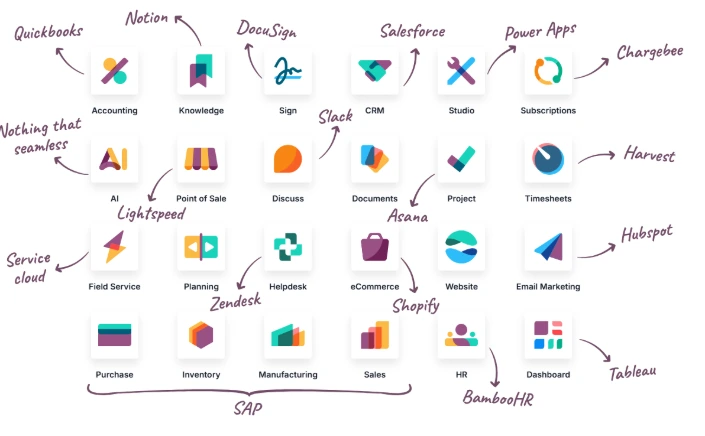
You already have a system. It is just spread over nine places.
The accounting package. The stock spreadsheet somebody keeps up to date. The quoting tool. The shared drive with the signed PDFs. The mailbox where orders arrive. The paper timesheets. Taken one by one, each of these does its job perfectly well.
The cost is not in any of them. It is in the retyping between them, and in the questions that should take ten seconds and take two days. Has that order shipped. Did we ever invoice it. What did that job actually cost us. How many of those do we have left.
An integrated system does not make your spreadsheet better. It makes the retyping unnecessary, and it makes those four questions answerable by anyone, at any moment.
Running the operation
From the first enquiry to the delivery note.

Sales and CRM
Leads, quotations that can be signed online, orders, price lists, and a portal where your customers follow their own documents instead of phoning you.

Inventory and purchasing
Several warehouses, barcode scanning, lots and serial numbers, automatic replenishment, and a stock figure that matches what is on the shelf.

Manufacturing
Bills of material, work orders, subcontracting, quality checks, and configurable products where the customer picks the combination.

Projects, timesheets and field service
Tasks, planning, hours logged from a phone, and the direct link between the time somebody spent and the line that appears on an invoice.
Running the company
The parts that keep the business itself in order.

Accounting and finance
Full Belgian accounting, bank statements imported and reconciled, supplier bills read automatically, budgets, analytic follow up and the statutory reports.

People and payroll
Employees, contracts, leave, expenses, recruitment, appraisals and fleet, connected to the timesheets rather than kept in a separate world.

Website and e-commerce
A website, an online shop and a customer portal reading the same catalogue, the same prices and the same stock as your back office.

And everything around it
Documents, electronic signature, helpdesk, marketing, events, approvals and spreadsheets. Most of them are a separate subscription somewhere else today.
Why companies end up choosing it
One price, every application
Odoo charges per user, not per module. Adding an application next year does not mean reopening a negotiation, which makes the arithmetic unusually easy to do in advance.
Your data stays yours
A standard PostgreSQL database and no proprietary file format. If you ever leave, you leave with everything, and the source code is public rather than locked in a vault.
It grows in stages
Start with quotations and invoicing this year. Add stock next year, production after that. Same system, same history, no migration project each time.

It is not a niche bet
A Belgian publisher, a new version every year, tens of millions of users, and a community of well over a hundred thousand developers around it.
Community or Enterprise: what the two editions really change
Odoo exists in two editions built on the same core. Community is open source and costs nothing in licence: you pay for hosting and for the work of setting it up. Enterprise is a subscription per user, with every application included.
Where it actually runs
Three ways to host it. The choice comes down to how much of your own code you intend to run.
Odoo Online
Odoo hosts it, backs it up and upgrades it. You stay inside what can be configured, which for many companies is the whole of what they need, and there is nothing to administer.
Odoo.sh
A platform built for Odoo where your own modules are deployed properly, with copies of your live database to test on before anything touches production. This is where most of our projects live.
Your own server
Complete control, and the responsibility that comes with it: backups, security, availability and upgrades are yours. It is also the only route if you run Community.
What comes with it
The parts nobody demonstrates, and that decide how the next few years go.
A new version every year
Odoo publishes a major version each year and keeps supporting the three most recent ones. It is a gift when the new version delivers, for free,
What you were about to pay somebody to build. It is a cost when the adaptations written for you have to be carried across, which is exactly why we argue about custom development before it is written.
Configured before it is developed
Most of what a company needs is a matter of setup rather than code: price lists, warehouse rules, document layouts, access rights, automatic reminders.
Real development starts only where the standard genuinely stops, and being open source is what lets it survive the next version.
It has to meet the rest of your world
Your banks through CODA and SEPA, electronic invoicing, your webshop, your carriers, and the two or three tools you are not replacing.
A system that runs the whole company still has to talk to the ones you keep, and that plumbing is a large part of what an integrator actually does.

A product is not a project
You could download Odoo this afternoon. What turns it into your system is a project: your way of working, your data, your people.
That is our profession, and the part that decides whether the software is a relief or a burden.
Where to go next
How we work
What a project looks like stage by stage, who you deal with, and what happens once you are live.
Finance and accounting
From the first quotation to the annual accounts, built to hold up when somebody asks how a figure was arrived at.
Logistics and manufacturing
Stock that matches the shelf, and production that receives what was actually sold.
Tell us what you run on today
Name the tools your company uses and the place where the retyping happens. We will tell you what Odoo covers as it comes out of the box, what needs configuring, what would genuinely need building, and where we think it would not be worth your money.